Phi Phi Islands by Catamaran from Krabi 2026: The Smooth-Ride Alternative to Speedboats — for Families, Older Travellers & Anyone Who Gets Seasick
Phi Phi by Catamaran from Krabi 2026 — Quick Answer
Most-asked questions about choosing the catamaran over the speedboat, answered before you read further:
| Question | Answer |
|---|---|
| Catamaran tour price 2026 | ฿2,950 per person — onboard buffet, drinks, all-day inclusions |
| Crossing time | ~90 minutes each way (vs. 45 min by speedboat) — but smooth, not slamming |
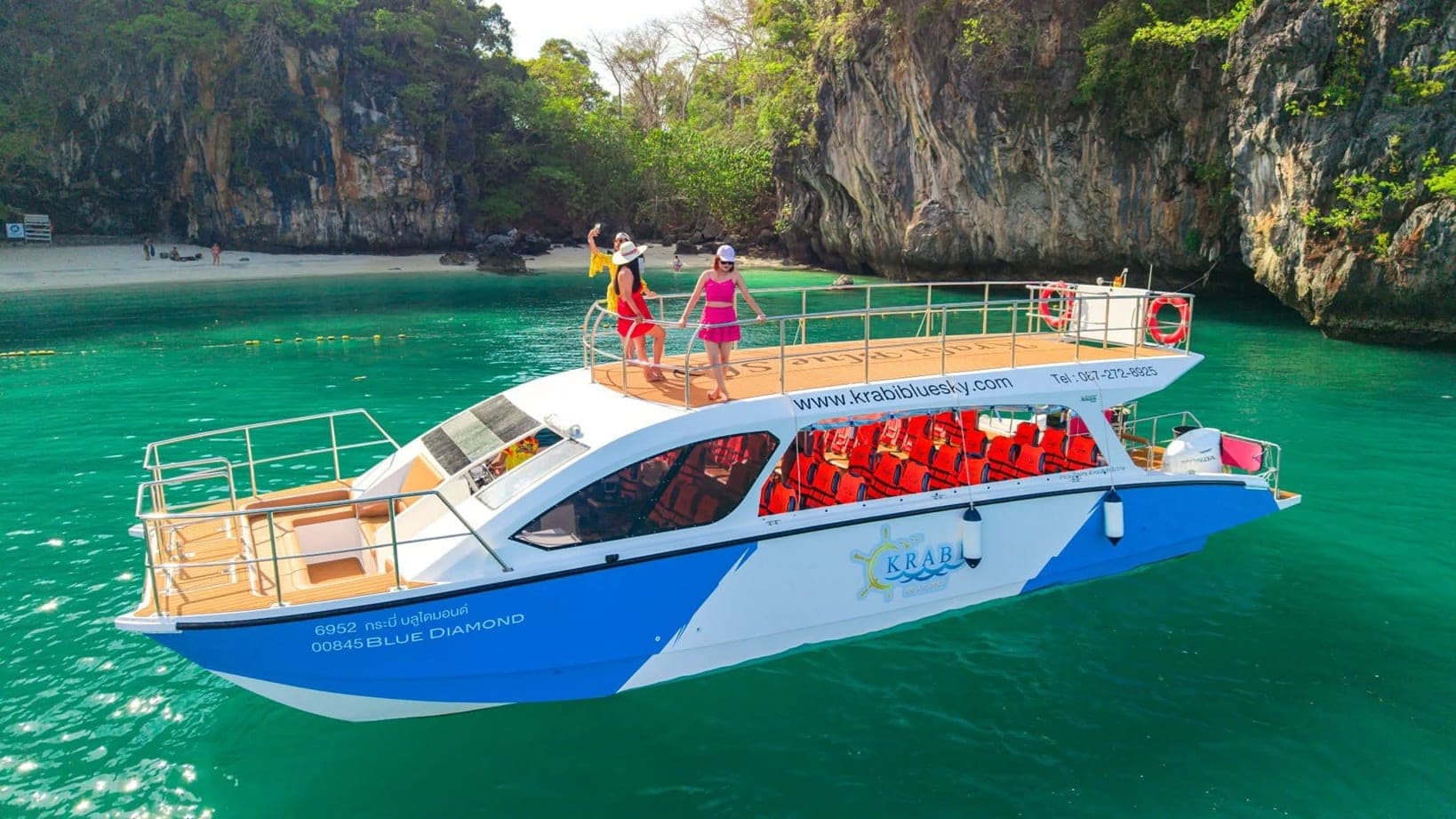
| Onboard amenities | AC cabin, shaded deck, real toilet, lounge seating, onboard buffet kitchen |
| Best for | Families with infants, older travellers, pregnancy, back issues, seasickness, honeymooners |
| National Park Fee | ฿400/adult, ฿200/child — paid at pier (not bundled, not marked up) |
| Pickup | Free Ao Nang. Krabi Town / Klong Muang / Tub Kaek +฿600/person |
| Closed dates | 1 August – 30 September (annual Maya Bay closure) |
| Same Phi Phi stops? | Yes — Bamboo Island, Pileh Lagoon, Maya Bay (boardwalk), Viking Cave, Phi Phi Don |
| Booking | Currently WhatsApp inquiry only — dedicated booking page launching soon |
✅ Ready to book the catamaran? WhatsApp us at +66 89 949 6235 with your dates and group size — we confirm in 15 minutes. Or read on for the full breakdown of why the catamaran is the right boat for some travellers, and the wrong one for others.
Phi Phi Islands Catamaran Tour from Krabi
From ฿2,950 per person — TAT Licensed Operator · Instant WhatsApp confirmation

The Real Reason We Recommend the Catamaran for Phi Phi
Most listings sell catamarans as the "luxury" option — implying it's the same product as a speedboat, just nicer. That framing misses the point.
The catamaran isn't a luxury upgrade of the speedboat. It's a fundamentally different boat solving a different problem. The speedboat's job is to get you there fast. The catamaran's job is to get you there comfortable, intact, and able to enjoy the day — and on more days than one, with energy left for tomorrow.
Here is who the catamaran is genuinely the right boat for, in our honest experience operating both:
- Families with infants and toddlers — speedboats are unsafe and uncomfortable for kids under 4–5; the catamaran has an AC cabin, a real toilet, and a calm ride
- Pregnant travellers — speedboat slamming is contraindicated in pregnancy; catamarans are commonly approved
- Older travellers (65+) — speedboat impact aggravates joints, hips, and balance issues; the catamaran is stable
- Anyone with back or spine issues — herniated discs, sciatica, recent surgery — the catamaran is the only safe option
- Anyone prone to seasickness — vestibular system reacts to vertical impact, not horizontal cruising
- Honeymooners and couples — arrive at the islands rested and photogenic, not sunburnt and exhausted
- Multi-day tour travellers — speedboat exhaustion ruins the next day's tour; catamaran preserves your energy
If you're a fit, healthy adult travelling for one day with no back issues and no kids under 6, the speedboat is fine and saves you money. If any of the above describes your group — even one person — the catamaran is worth every Baht of the difference.
The Wave Physics: Why a Catamaran Rides Smoothly Where Speedboats Slam
This is the part most articles skip, because it sounds technical. But once you understand what's happening to your body on a speedboat, you understand why the catamaran is a different experience entirely.
What a speedboat actually does to you
A speedboat uses a planing hull — at high speed (35–40 knots), the boat lifts most of its hull out of the water and rides on top of the surface. This works perfectly on glass-flat water. The instant the sea has any chop, the hull lifts off the back of one wave and crashes down onto the front of the next.
Each crash sends a shock wave up through the hull, the seat, and your spine. On a typical Phi Phi crossing of 45 minutes, you're absorbing 60 to 200 of these impacts depending on sea state. Light chop (10–15 cm waves) causes mild but constant impact. Moderate chop (30–60 cm waves) causes hard slamming that bruises tailbones, aggravates back conditions, and triggers motion sickness. The body's vestibular system isn't designed for repeated vertical impact — it's what causes the nausea, exhaustion, and headache that many guests describe after speedboat days.
This is why on choppy days speedboat captains have to slow down dramatically (sometimes to 15 knots or less) — not for your comfort, but to protect the hull from damage.
What a catamaran does instead
A catamaran has two parallel V-shaped hulls with a deck bridging them. Each hull is shaped like a sharpened wedge — a deep V at the entry that cuts through the wave's face instead of climbing over it, designed specifically to cut through wave energy at the waterline rather than fighting it from above. Between the two V-shaped hulls, the wave troughs pass underneath the deck without lifting it.
The result is geometric: the boat barely moves vertically, regardless of sea state. The twin V-shaped hulls slice through chop at the waterline; the deck stays level; your body stays still. Spray is minimal because the V-hulls cut the water cleanly instead of crashing into it.
In numbers: a speedboat in 50 cm chop will deliver perhaps 80 hard impacts on a 45-minute Phi Phi crossing. A catamaran with V-shaped hulls in the same 50 cm chop delivers near-zero perceptible vertical motion. This is not a marketing claim — it's the actual physics of the two hull designs.
The honest tradeoff
A catamaran is slower than a speedboat in absolutely calm conditions. Top speeds:
- Speedboat: 35–40 knots when conditions allow
- Power catamaran: 22–28 knots
So the catamaran takes about 90 minutes to reach Phi Phi versus 45 minutes for a speedboat — assuming both are running flat-out. But here's what most listings don't tell you: speedboats rarely run flat-out. Even moderate chop forces them to throttle back. On rougher days a speedboat cruises at 18–22 knots while a catamaran cruises at 22–25 knots smoothly. The actual crossing times often end up much closer than the speedometer numbers suggest.
What you give up with the catamaran is 30 to 45 minutes of total transit time on a calm day. What you gain is comfort that genuinely transforms whether your body can do this trip at all.
The Five Travellers the Catamaran Was Built For
These aren't theoretical use cases. These are real types of guests we've sent on the catamaran where the speedboat would have failed them.
1. Families with infants and toddlers (under 4 years old)
We sent a family with a 1-year-old on this catamaran last season. The mother messaged after the trip to thank us — she said the catamaran was the only reason they could see Phi Phi as a family rather than missing it because the toddler couldn't handle a speedboat. Speedboats simply aren't built for very young children: life jackets don't fit small bodies properly, the impact and noise are unsafe, and an unsteady toddler on a slamming boat is a real injury risk.
The catamaran works for infant families because:
- Calm enough that infants can sit on a parent's lap, nurse, or sleep during the crossing
- Indoor air-conditioned cabin if the baby needs a nap or relief from the sun
- Proper toilet for nappy changes (no holding it for seven hours or improvising on a speedboat's back deck)
- Bench and lounge seating for parents instead of a hard speedboat bench
- Slower, calmer pace at each stop
If you have a child under 4 and you want to see Phi Phi, this is the boat. If you have a child under 4 and you book a speedboat anyway, you will regret it.
2. Older travellers (65+)
Speedboat slamming is brutal on aging joints, hips, and spines. The vestibular changes that come with age also make seasickness worse. We have older guests who tried a speedboat to Phi Phi years ago and swore off boat tours afterward — until they tried the catamaran and discovered it was a different experience entirely.
What older travellers gain on the catamaran:
- Smooth ride that doesn't compress the spine 60 times per crossing
- Stable boarding from the pier (catamaran sits flat at the dock, doesn't bounce on the swell)
- AC cabin with proper seating to rest between stops
- Real toilet (especially important for older guests with bladder/prostate concerns)
- Walking-friendly deck (no climbing over benches like on a speedboat)
- Crew time and patience — smaller group means crew can actually help
If you're travelling with parents, grandparents, or you're 65+ yourself — the catamaran is the boat to choose.
3. Pregnant travellers
The Phuket luxury catamarans we researched explicitly note: "Guests over 75 or pregnant women are advised against speedboats due to the physical demands and safety considerations." This advice is consistent across operators because speedboat slamming poses real risks during pregnancy.
The catamaran's smooth ride is genuinely safe for healthy pregnancies. Honest framing:
- Always consult your doctor before any boat tour during pregnancy
- Tell us at booking that you're pregnant so the crew is briefed
- The catamaran's onboard toilet, AC cabin for rest, fresh fruit and drinks make it dramatically more comfortable than any speedboat
- Avoid the tour entirely in the first trimester, the third trimester, or in any complicated pregnancy
For a healthy second-trimester traveller wanting to see Phi Phi, the catamaran is the only realistic option from Krabi.
4. Anyone with back, spine, or joint issues
This is the case I want to be most direct about. Owner's note: my own sister has a back condition. She tried a speedboat to Phi Phi years ago and was unable to walk normally for three days afterward. On the catamaran, she did the same Phi Phi day with no pain at all.
If you have:
- Lower-back pain or sciatica
- Herniated or bulging discs
- Recent spine surgery or epidural treatments
- Tailbone or coccyx injuries
- Hip replacements or hip pain
- Osteoporosis or any condition involving bone density
- Any chronic pain made worse by physical impact
The catamaran is not optional for you — it's the only safe Krabi boat option to Phi Phi. The speedboat will hurt you, sometimes badly, sometimes for days. We've sent guests with serious back conditions on this catamaran who were able to do Phi Phi when nothing else would have worked.
5. Honeymooners and couples who want to look good in photos
A less serious case, but a real one. Speedboat day = arrive at the islands with sea-spray-stiffened hair, sunburnt face, sweat-stained clothes, exhausted from the slamming, and no time to recover before the photo stops. Honeymoon photos at Pileh Lagoon are not flattering when one of you is windblown and the other is green from seasickness.
Catamaran day = arrive at Pileh after a calm 90-minute cruise, hair intact, makeup intact, energy intact, photos that actually look like the honeymoon you booked. You also have access to the AC cabin to refresh between stops, a real toilet to do hair and touch-ups, and onboard food that doesn't require eating on a wobbly speedboat bench.
For honeymooners specifically, the catamaran is genuinely the right call.
6. Multi-day Krabi travellers — the energy argument
This is the case most travellers don't think about until it's too late. A speedboat to Phi Phi on Day 1 of your Krabi trip will exhaust you. Lower-back fatigue, mild sunburn, slight dehydration, residual seasickness, hard sleep that night. Day 2, you wake up tired before the next tour even starts.
If you have one tour booked in Krabi, it doesn't matter much. If you have three tours booked across three days — Phi Phi, 4 Islands, Hong Islands — speedboats will accumulate. By Day 3 you'll be wishing you'd skipped one of them. The longer the tour and the more open-ocean crossing involved, the more dramatic the fatigue effect: Phi Phi has the longest crossing of any Krabi day tour, which makes the boat choice for Phi Phi Day disproportionately important to how the rest of your week feels.
The catamaran on Day 1 leaves you fresh for Day 2. We've had guests do back-to-back catamaran-then-speedboat days successfully, but never the other direction. If your Krabi itinerary includes more than one boat day — and most multi-day Krabi itineraries do — putting the catamaran on the longest crossing (Phi Phi) and saving the speedboats for the shorter days (4 Islands, Hong Islands) is the ergonomically smart sequence.
7. Why Phi Phi specifically — the longest open-ocean crossing in Krabi
Worth understanding: the Phi Phi crossing from Ao Nang is the longest open-ocean transit of any standard Krabi day tour. The 4 Island Tour stays close to the Krabi coast in sheltered water — short hops between islands, calm conditions most days. Hong Islands is similarly sheltered. Phi Phi is genuinely 45 kilometres out into the open Andaman, exposed to whatever the wind and tide are doing. This is why the Phi Phi crossing is the one that breaks people on speedboats — it's the longest single segment of any Krabi day tour, in the most exposed water.
If you were going to upgrade exactly one Krabi day to the catamaran, the Phi Phi day is the one to upgrade. The 4 Island Tour by speedboat is genuinely fine for almost everyone because the conditions are calmer. Phi Phi by speedboat is the day that punishes the wrong bodies.
What's Actually on Board the Catamaran
The honest tour of the boat. We're describing what's on a typical Phi Phi catamaran from Krabi — not a Phuket party-boat with 98 guests and a DJ.
The cabin and deck layout
Indoor air-conditioned cabin — proper enclosed space with seating, escape from the sun, the wind, and the spray. Big windows for the view. Useful for naps, hot mid-day stretches, anyone who's overheated, parents with sleeping infants, or simply rotating between sun and shade across the day.
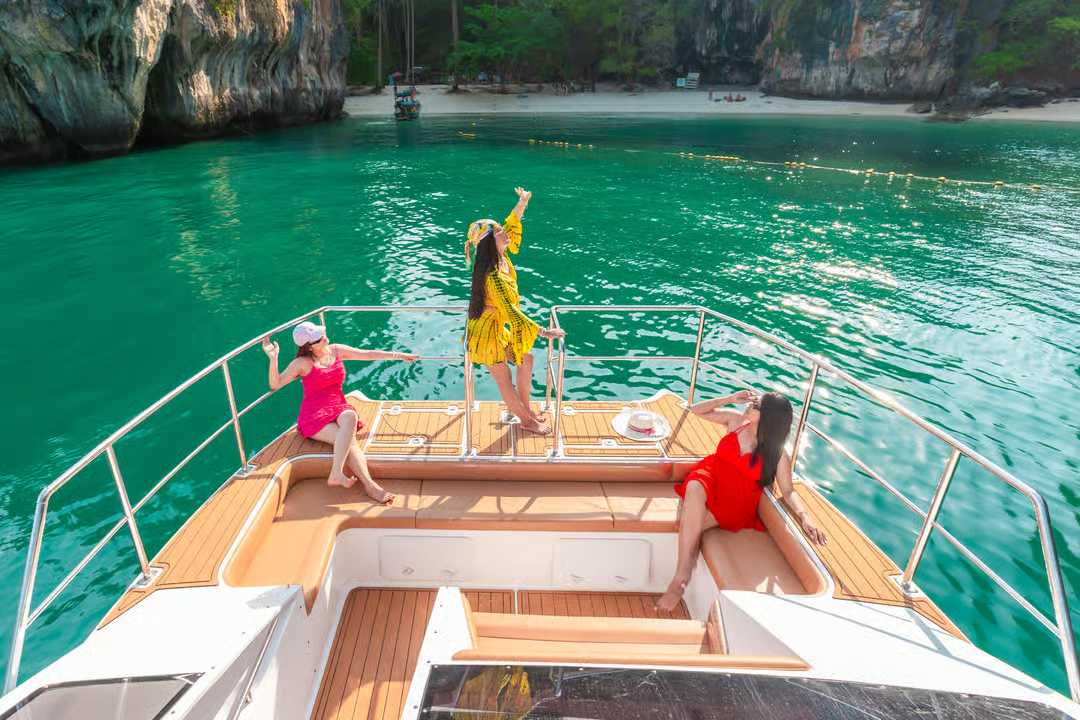
Shaded outdoor deck — covered seating area with bench and lounge options. The view is best from out here; you spend most of your time in this space watching the islands pass.
Open sun deck — for guests who want direct sun, photos, or to stretch out on a deck pad. Usually accessed from the cabin roof or upper deck depending on the boat.
Swim platform at the stern — flat platform at water level for easy entry and exit at the snorkel stops. Much easier than dropping off the side of a speedboat.
The kitchen and dining
Onboard galley kitchen — the buffet is prepared and served onboard. This is a meaningful difference from speedboat tours where lunch is at the crowded Phi Phi Don beach restaurant shared with hundreds of other tour guests.
Dining tables on deck — proper seating to eat at, in shade, with the ocean view, without 200 strangers around you.
Halal-friendly preparation — available on request at booking. Tell us when you book and the kitchen prepares your portion separately. Vegetarian options also available with notice.
Drinks throughout the day — bottled water, soft drinks, fresh fruit (typically pineapple, watermelon, in season). Tea/coffee usually available.
The toilet (yes, this matters)
A proper marine toilet with door, basic facilities, and reasonable privacy. Speedboats either have no toilet at all or a curtain-and-bucket arrangement on the back deck where everyone can see your feet. For a 9-hour day this difference is significant — especially for women, children, older travellers, anyone with bladder concerns, anyone who's pregnant, and anyone who wants to drink water without rationing.
The safety equipment
Standard for all Thai-licensed catamarans: life jackets in working condition for every guest including child sizes, marine VHF radio for weather and emergency comms, GPS chart plotter, fire extinguishers, first aid kit. Snorkelling masks issued individually, mouthpieces clean. (Bring your own fins if you want them — fins are not provided as standard.)
What the Catamaran Day Looks Like (Step by Step)
8:00–8:30 AM: Hotel pickup from Ao Nang (strict)
Same pickup window as the speedboat tour. Driver does not wait for late guests; be in the lobby ready to board. Krabi Town, Klong Muang, or Tub Kaek pickup is approximately 30 minutes earlier (around 7:30 AM) with the +฿600/person surcharge applied at booking.
9:00 AM: Pier arrival, National Park Fee, board the catamaran
Same pier as the speedboat (Nopparat Thara or Ao Nam Mao depending on the day's catamaran). Pay the National Park Fee directly to the park ranger: ฿400 per adult and ฿200 per child (4–11 years). Cash in Thai Baht. Keep your receipt — it's your park entry pass for the day.
Boarding the catamaran is from a proper jetty (no wet beach boarding). The boat sits flat at the dock — much easier than climbing into a speedboat that's bouncing on the swell.
9:00–10:30 AM: Cruise to the Phi Phi Islands (~90 minutes)
This is the part the catamaran transforms. The crossing is the longest single boat segment of the day, and on a speedboat it's the part that breaks people. On the catamaran, it's part of the experience. Some guests sleep. Some sit on the deck and watch Krabi disappear behind them. Some have breakfast on board (we sometimes serve a light morning fruit and pastry option for early risers). The crossing time genuinely flies because the boat is comfortable enough that you stop thinking about it.
10:30 AM – 4:00 PM: The Phi Phi stops
Same itinerary as the speedboat tour with the same time at each stop:
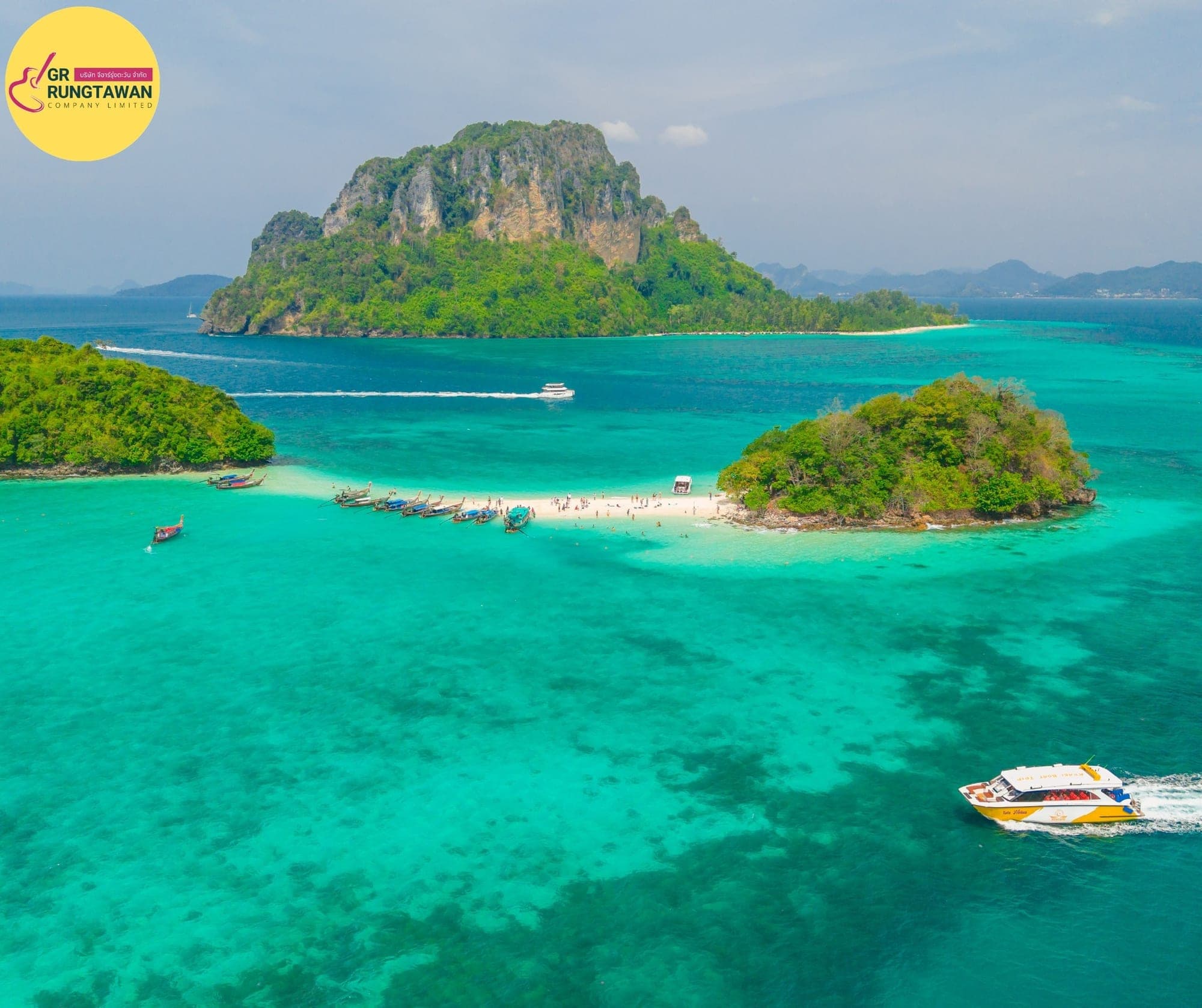
- Bamboo Island — snorkelling, white sand beach, fewer crowds than Maya
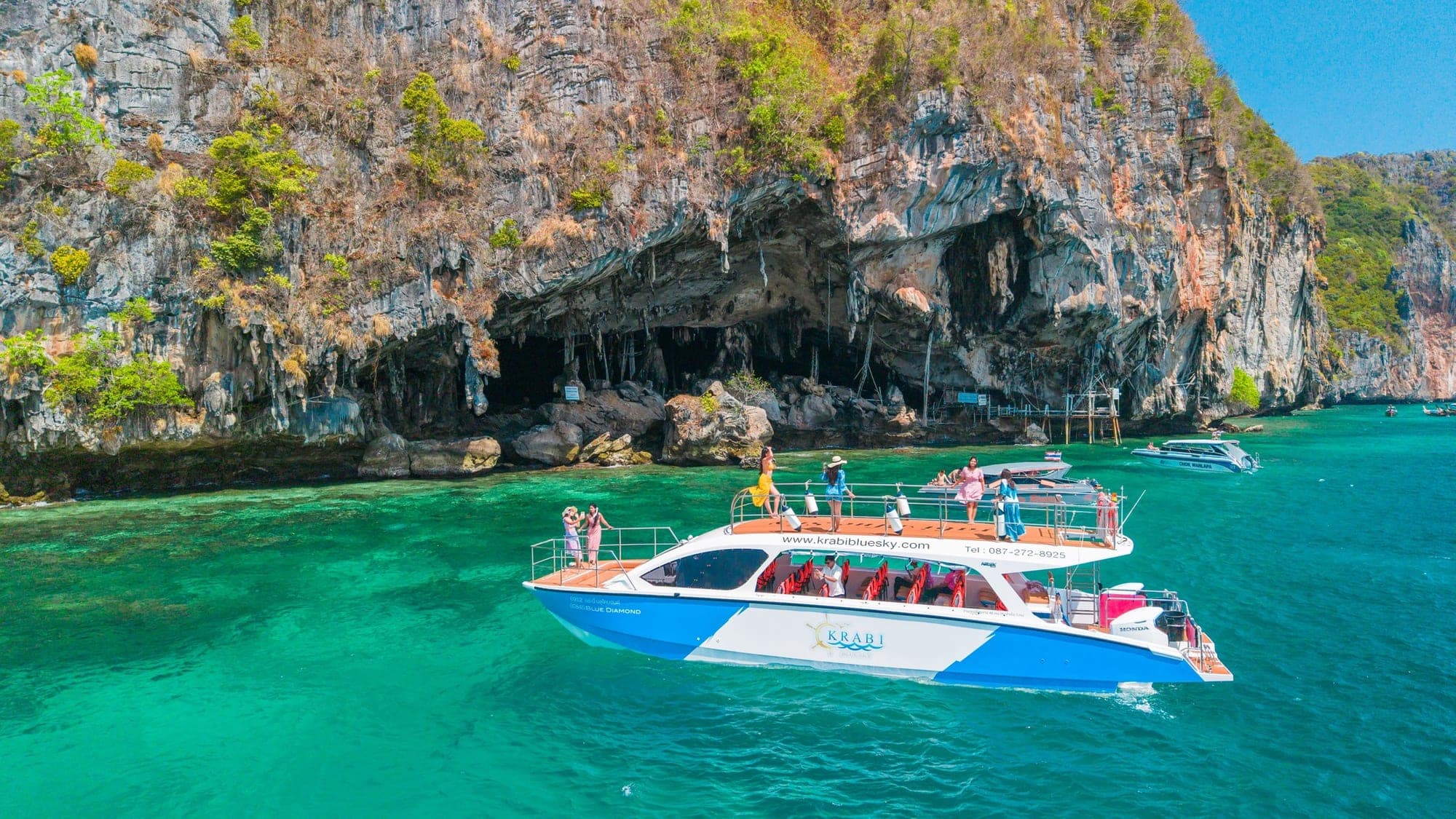
- Viking Cave — photo stop at the swiftlets nest cave
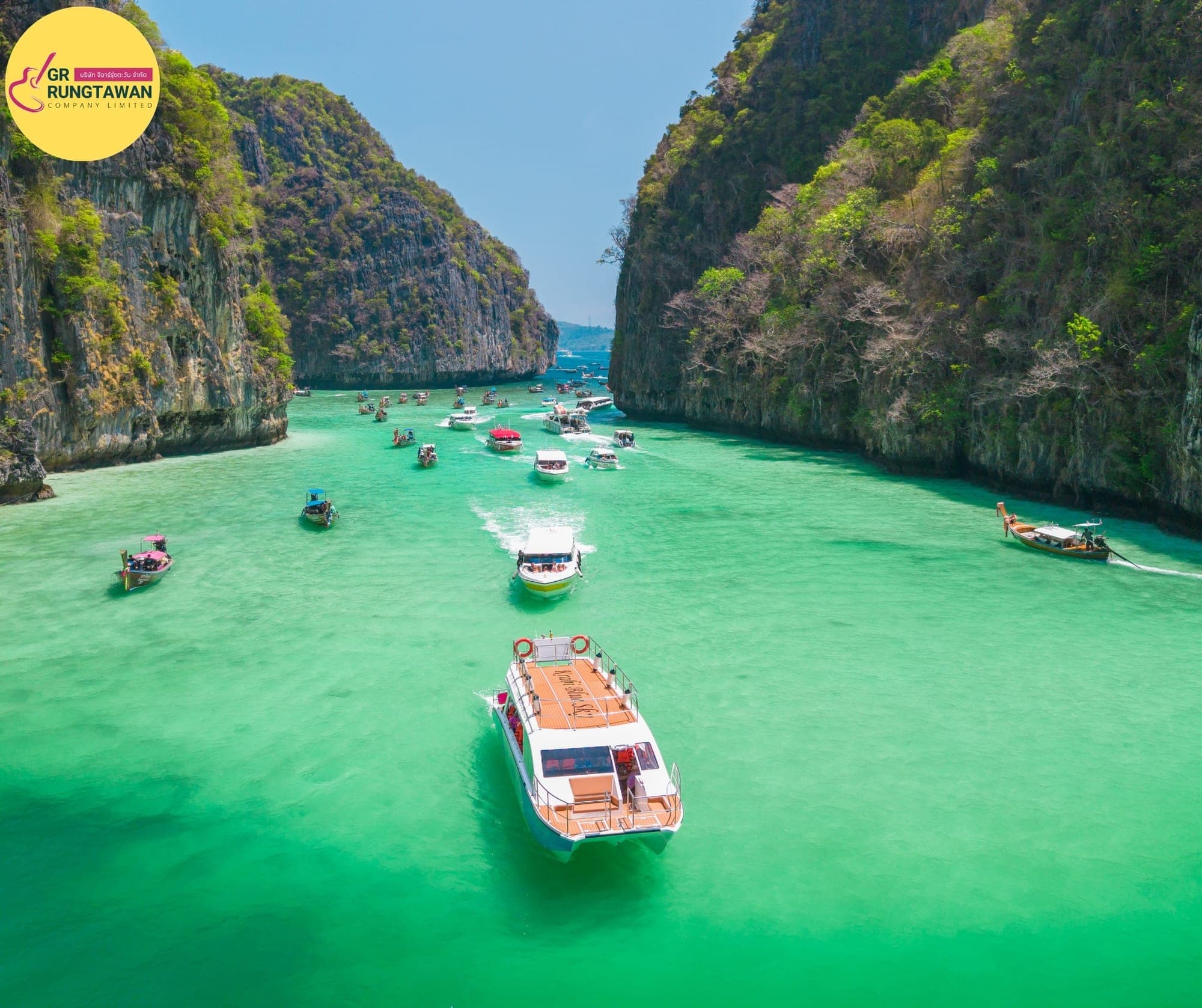
- Pileh Lagoon — swim in the enclosed turquoise water surrounded by 100m cliffs
- Maya Bay — boardwalk visit from Loh Samah Bay, ~1 hour, no swimming (since 2022)
- Phi Phi Don — but this is where the catamaran does it differently. Lunch is on the catamaran itself, anchored offshore, not at the crowded Phi Phi Don beach restaurant. This alone is worth the catamaran upgrade for many guests.
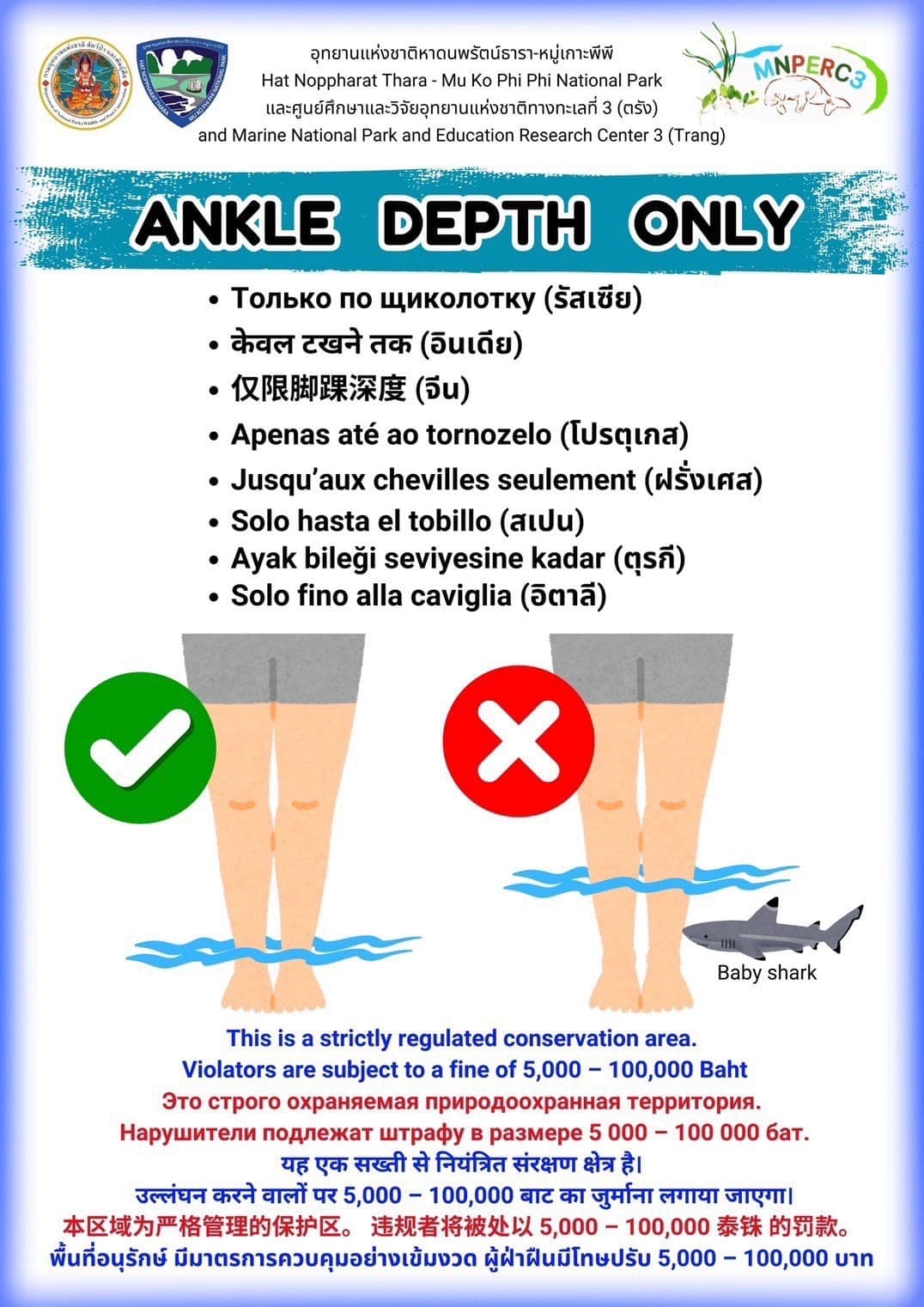
Official National Park Rules — Applies to Every Stop on the Catamaran Tour
Mu Ko Phi Phi National Park is a strictly protected conservation area. The following rules are enforced by park rangers at every island stop — Bamboo Island, Pileh Lagoon, Maya Bay, Viking Cave, and Phi Phi Don. Violations carry fines of ฿5,000–100,000 Baht under the National Parks Act and the Wildlife Conservation and Protection Act. Our guide briefs the complete list before the catamaran departs.

About Monkey Beach: Feeding monkeys is strictly prohibited under national park regulations (fine: ฿5,000–100,000 Baht). The catamaran approaches closely for observation and photography — you will get excellent views of the macaque colony. Our crew cannot provide food for the monkeys. Hold onto your belongings.
The order varies by tide and Maya Bay's morning capacity slot. Our 9:00 AM departure is timed to arrive at Maya Bay before the 10:30 AM saturation point — same logic as the speedboat tour.
4:00–5:00 PM: Return cruise to Krabi
90-minute return cruise. On a calm day, this is the moment guests realize they've actually enjoyed every part of the day — including the boat ride. Many guests fall asleep on the lounge seating. Some have a final drink and watch the sunset color the cliffs.
~5:00 PM: Hotel drop-off
Minivan back to your Krabi hotel. Ao Nang drop-off ~5:00 PM. Krabi Town / Klong Muang / Tub Kaek drop-off ~5:30 PM. Day done.
When the Catamaran Is the WRONG Choice
To be fully honest — this matters because we don't want to oversell:
- You're a fit healthy solo traveller or couple under 50, no health issues, doing only one day in Krabi → the speedboat is fine and saves you ฿1,250/person. Take the speedboat.
- You want a party-boat day with DJ, drinks, water slide, sunset rave → this is not that. Book a Phuket party catamaran.
- You want to be back at your Krabi hotel by 4:00 PM for an evening commitment → catamaran returns ~5:00 PM, longer day overall. Speedboat returns 4:30 PM.
- You're travelling 1 August – 30 September → Maya Bay is closed; we don't run any Phi Phi tours during this window. Take the 4 Island Tour instead.
- Your budget is genuinely tight and ฿2,950 is a stretch → the Phi Phi Speedboat Tour at ฿1,700 is the responsible recommendation.
Honest selling matters. The catamaran is the right boat for some travellers and not others. We'd rather tell you the truth and have you book the right product than oversell and have you write a 1-star review afterward.
How to Book
⭐ "My back has been a problem for ten years. I'd been told repeatedly that Phi Phi was off the table because of the speedboat ride. The catamaran from Trip Thai Tour was the first time anyone said 'there is actually another way.' Calmest 9 hours I've spent on a boat — finished the day pain-free, did the 4 Islands tour the next morning, and saw more of Thailand in one trip than I'd thought possible. Worth every Baht of the difference." — Margaret D., Adelaide, Australia (verified Trip Thai Tour booking, 2026)
Ready to book the catamaran?
✅ WhatsApp inquiry only for now — message us at +66 89 949 6235 with your travel dates, group size, ages of children if any, hotel name in Krabi, and any halal or vegetarian dietary requirements.
✅ Confirmation in 15 minutes during business hours (7 AM–9 PM Bangkok time). We confirm boat availability and pricing on the spot.
✅ TAT Licensed Tour Operator — License No. 14/04232, verifiable at tourismthailand.org. You're booking with a registered Thai tour operator — important on a 9-hour day on the open Andaman Sea.
✅ Dedicated catamaran booking page launching soon — for now WhatsApp is the only booking channel because we want to confirm the specific catamaran and date availability personally for each booking.
Not sure if the catamaran or the speedboat is right for you? Read our Phi Phi Islands Speedboat Tour page and our complete Phi Phi Islands tour guide for the full comparison. Or just WhatsApp us with your situation — we'll tell you honestly which boat fits.
For broader Krabi planning, browse our Krabi tours — most travellers staying 3+ days pair Phi Phi with the Krabi 4 Island Tour. Learn more about Trip Thai Tour on our About page.
Phi Phi Islands Catamaran Tour from Krabi
From ฿2,950 per person · TAT Licensed No. 14/04232 · ⭐ 4.0 (186 reviews)
Related Krabi Travel Guide
If you're planning your Krabi itinerary, don't miss our comprehensive guide for 2026. We compare all major tours, explain how to beat the crowds at Maya Bay, and provide an honest breakdown of what's actually worth your time.
👉 Read more: Things to Do in Krabi 2026: The Complete Honest Guide
Frequently Asked Questions
The single biggest reason is the ride. A speedboat is a planing hull that lifts out of the water and slams down on every wave — 45 minutes of constant impact each way. A catamaran has twin V-shaped hulls that cut through waves at the surface; the boat barely moves vertically. The result is a smooth, dry, comfortable crossing that doesn't leave you exhausted, sunburnt, or sore. Specifically essential for families with infants, pregnant travellers, older guests, anyone with back or spine issues, and anyone who's ever been seasick on a speedboat. Honest tradeoff: catamaran is slower in calm seas (about 90 minutes vs. 45 minutes each way), but the day is built around this — you depart earlier and the comfort is worth the extra hour.
Yes — and this is the question we recommend you take seriously if it applies to you. Speedboat slamming creates compressive shock through the spine 60+ times during a 45-minute crossing. For anyone with lower-back issues, sciatica, herniated discs, hip problems, or osteoporosis, this is genuinely painful — and on a rough day it can cause new injury. The catamaran's twin-hull design means almost no vertical impact even in moderate sea state. Older travellers consistently arrive at the islands feeling fine, instead of needing to recover. We've sent guests with serious back problems on this catamaran who said it was the only way they could have done Phi Phi at all.
Yes — and this is one of the situations the catamaran genuinely solves. Speedboats are inappropriate for infants under about 4 years old: the impact and noise are unsafe, life jackets don't fit small bodies properly, and the open environment is dangerous for unsteady toddlers. The catamaran is calm enough that infants can sit on a parent's lap, sleep, or nurse during the crossing. There's a proper indoor cabin with air conditioning if the baby needs to nap or get out of the sun, and a real toilet for nappy changes. For families with kids under 4, the catamaran is the practical option.
Yes — most catamaran operators in Thailand allow pregnant women on board, while speedboats explicitly advise against it (the slamming can cause serious harm). The catamaran's smooth ride means pregnant guests can comfortably do the day. Honest distinction: we recommend asking your doctor before any boat tour during pregnancy, and we recommend telling us at booking if you're pregnant so the crew is aware. The catamaran's onboard toilet, AC cabin for rest, and fresh fruit/drinks make it dramatically more comfortable than any speedboat option.
Big difference. The famous Phuket luxury catamarans are typically 45–98 guests, with a DJ, open bar, water slide, sunset party atmosphere — they are essentially booze cruises with snorkelling stops. Our Krabi catamaran is the opposite: small group, calm, family-friendly, focused on comfort and the islands themselves rather than the boat-as-venue. If you want a party day, those Phuket boats are great. If you want a comfortable, refined day with elderly relatives, kids, or someone who needs a smooth ride, this is the boat.
Physics. A speedboat is a planing hull — at speed, it lifts out of the water and rides on top of it. Every wave it hits, the hull slams down on the wave's face. On choppy days the slamming is constant and hard, which is why speedboat passengers describe arriving 'beaten up'. A catamaran has two parallel V-shaped hulls that cut through waves at the waterline. The boat bridges wave troughs instead of crashing over them. The deck stays level, the ride stays smooth, and even in 1.5–2 metre swell the catamaran feels significantly calmer than a speedboat in 0.5–1 metre swell. Speedboats also have to slow down dramatically in chop or risk damage; catamarans cruise through the same chop at near-full speed. On rough days the actual crossing time is often similar.
Yes — a proper marine toilet with door and basic facilities. Speedboats either have no toilet or a curtain-and-bucket arrangement on the back deck. For 7+ hour day trips this matters more than guests typically think — especially for women, children, older travellers, and anyone with health conditions affecting bladder control. The catamaran toilet is one of the things our regular guests mention specifically when asked why they upgrade.
Onboard, on the catamaran itself. This is a meaningful difference from the speedboat tours, where lunch is at a buffet restaurant on Phi Phi Don shared with hundreds of other tour guests. The catamaran serves a buffet lunch at your own dining tables on the deck, with shade, with proper seating, and without the crowd. Halal-friendly preparation is available on request at booking. Vegetarian options also available with notice. The food is genuinely better than the Phi Phi Don beach restaurant in our experience — the catamaran kitchens prepare smaller volumes more carefully.
Indoor air-conditioned cabin (escape the sun, the wind, or both), shaded outdoor deck for the views, proper bench and lounge seating throughout, marine toilet/bathroom, onboard kitchen for the buffet, dining tables, snorkelling masks and life jackets in working condition, fresh fruit and bottled water and soft drinks, swim platform at the rear for easy water entry. Modern power catamaran with twin engines and V-shaped hulls.
฿2,950 per person, all-in for the day except the National Park Fee. The price includes the catamaran, English-speaking guide, onboard halal-friendly buffet lunch, drinks throughout, snorkel mask and life jacket, free pickup from Ao Nang hotels, and insurance. The National Park Fee (฿400/adult, ฿200/child) is paid directly to the park ranger at the pier — we never include it in the booking price because that creates a hidden markup we want to avoid. Krabi Town, Klong Muang, or Tub Kaek pickup is +฿600 per person.
No. Maya Bay is closed by the Thai marine authority every 1 August through 30 September for coral recovery. We do not run any Phi Phi tours during this period — speedboat or catamaran — because Maya Bay is the main attraction. If you are travelling in those months, please book our <a href='/Krabi/4Island'>Krabi 4 Island Tour</a> instead. The catamaran tour resumes 1 October.
No — and this isn't a catamaran-specific limitation. Since Maya Bay reopened in January 2022 after a four-year coral recovery closure, swimming is permanently banned for all visitors regardless of which boat brings you. Visit time at Maya Bay is approximately 1 hour, walking the beach via boardwalk from Loh Samah Bay. You can swim freely at Pileh Lagoon and Bamboo Island during the same tour.
About 90 minutes each way at typical cruising speed. Speedboats do the same crossing in 45 minutes. The 45-minute difference is real — but it's also the entire reason the ride is comfortable. The catamaran's slower cruising speed means the hulls cut through waves cleanly instead of slamming over them. Our day is built around this longer transit: pickup is 8:00–8:30 AM (same as speedboat tours), the boat departs around 9:00 AM, and we return to Krabi by approximately 5:00 PM. You get a full day on the islands and a comfortable journey both ways.
Yes. The famous Phuket luxury catamarans run 45–98 guests per boat — they're essentially floating event venues. Our Krabi catamaran is a much smaller boat designed around comfort rather than capacity. We don't quote a hard guest cap on this page because it varies by boat configuration, but the experience is genuinely different from the Phuket party-boat scene: more space per person, calmer atmosphere, more attention from the crew. WhatsApp us with your travel dates and we'll confirm the specific boat and capacity for that day.
Free pickup from Ao Nang hotels (Ao Nang Beach, Ao Nang Centre, Hat Noppharat Thara). Pickup is strict 8:00–8:30 AM — driver does not wait for late guests. For Krabi Town, Klong Muang Beach, or Tub Kaek hotels, add ฿600 per person to cover the longer transfer (pickup approximately 30 minutes earlier). We do not pick up from Railay Beach (no road access — boat-only), Tonsai Bay, Centara Grand Beach Resort, Nong Thalay, or Ao Nam Mao.
Currently by WhatsApp inquiry only — message us at +66 89 949 6235 with your travel dates, group size, ages of children if any, hotel name, and any halal or vegetarian requirements. We confirm availability and quote within 15 minutes during business hours (7 AM–9 PM Bangkok time). The dedicated catamaran booking page is launching soon; in the meantime all bookings go through WhatsApp so we can confirm boat availability for your specific date.
Check Availability & Book
Send us your details to get an instant quote and secure your date.
Related Guides
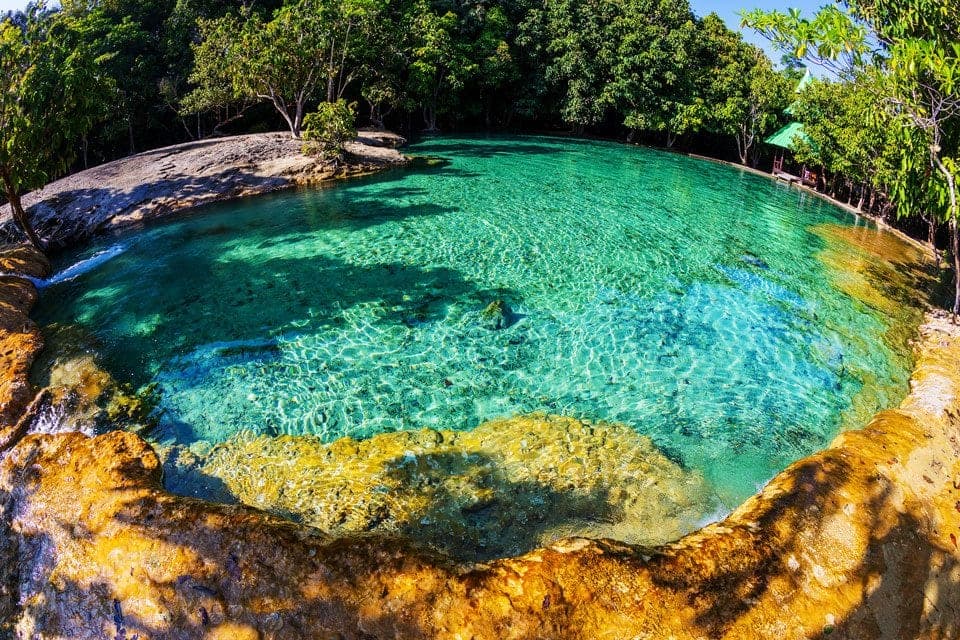
Krabi Jungle Tour 2026: Emerald Pool, Hot Springs & Tiger Cave — How to Beat the Crowds & Survive the 1,260 Steps
Krabi Jungle Tour 2026 — Hot Springs Waterfall, Emerald Pool, Blue Pool, Tiger Cave Temple. Honest guide to the 1,260 steps. 8 AM start beats crowds. ฿2,200/adult.
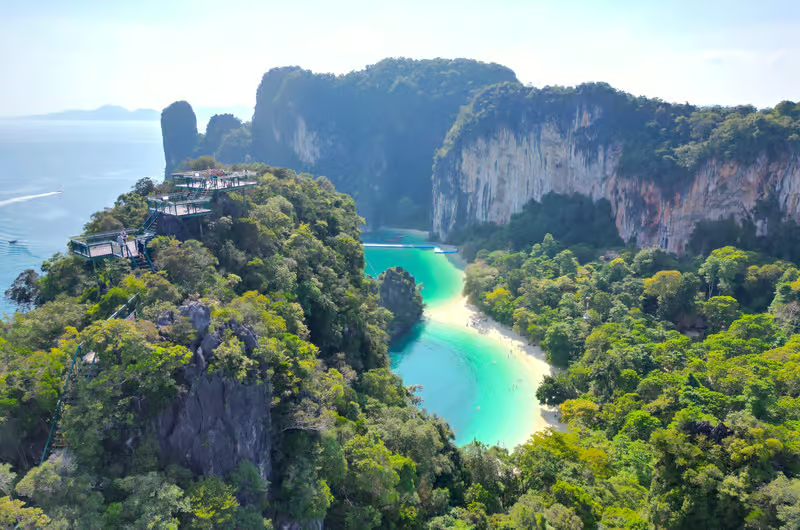
Hong Islands Tour from Krabi 2026: Tickets ฿1,500, 109m Viewpoint, the 'Room within the Island' & How to Avoid the Crowds
Hong Islands tour from Krabi 2026 — Hong Lagoon, 109m viewpoint, Pakbia sandbar, Lading snorkeling. ฿1,500/adult group speedboat, halal lunch, English guide, Ao Nang pickup.
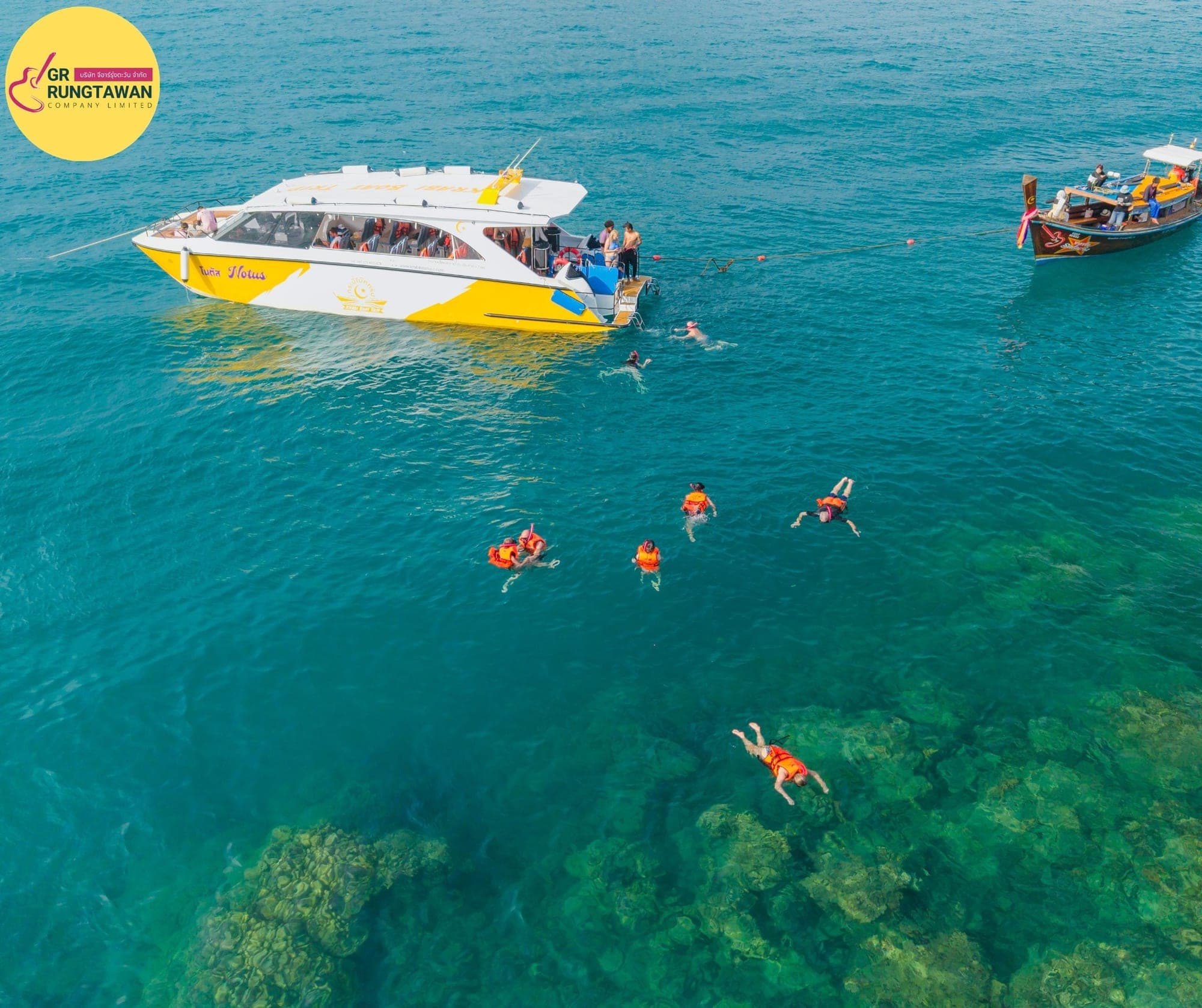
Krabi Phi Phi Island Tour by Speedboat 2026: The Honest Guide — Maya Bay Rules, Pileh Lagoon, Viking Cave & Why You Need to Book a Maintained Boat
Phi Phi Island tour from Krabi by speedboat 2026 — honest guide to Maya Bay's new rules (no swimming since 2022), Pileh Lagoon, Viking Cave, Bamboo Island. Why advance booking matters. Aug–Sept closure disclosed. ฿1,700 per adult.