Thailand Elite Visa Bronze Ends 30 September 2026: The Real Deadline, the Maths, and What Replaces It
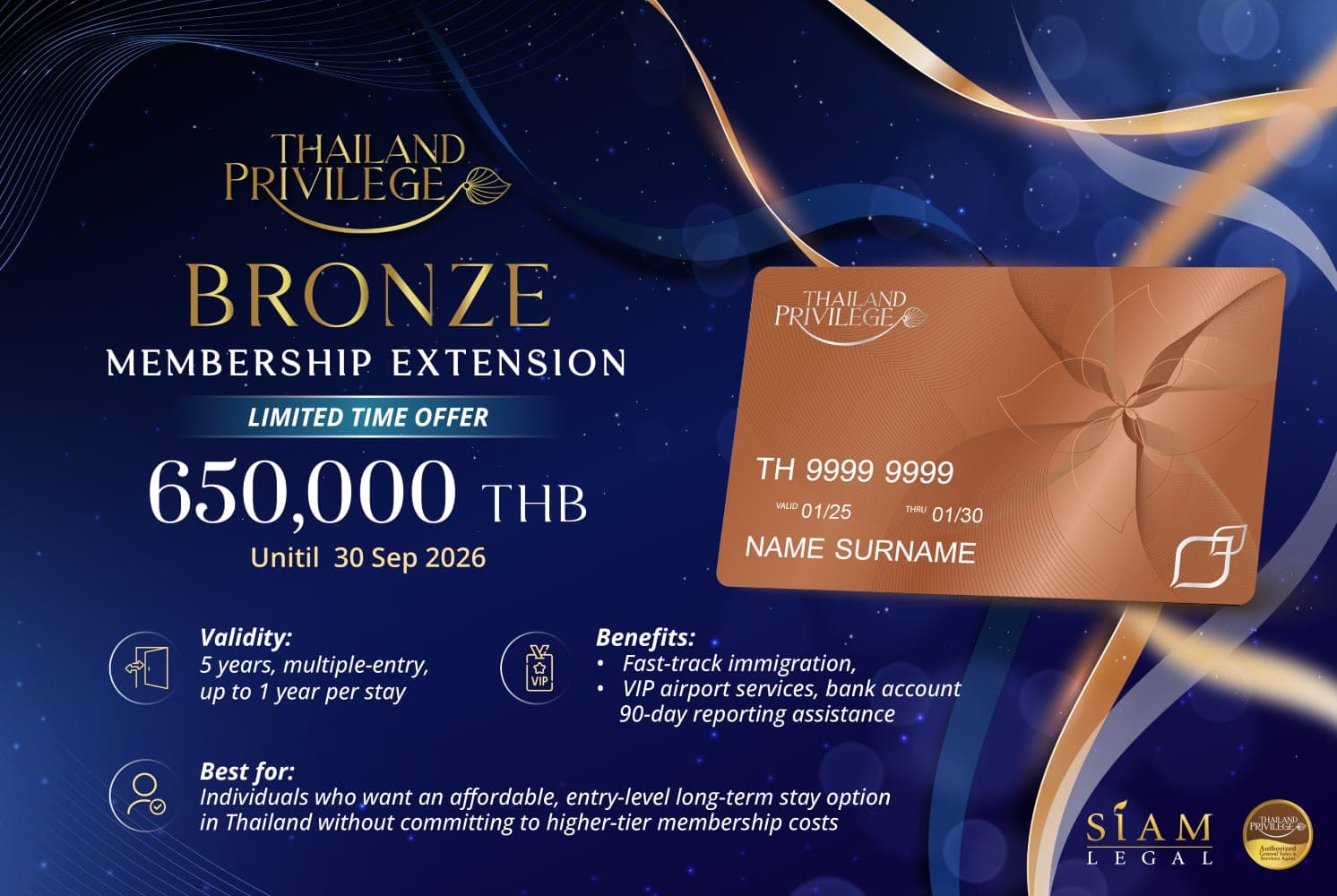
Thailand Privilege Bronze — the tier most people still call Thailand Elite Bronze — closes to new applications on 30 September 2026. After that date the cheapest way into the programme is Gold at ฿900,000. The entry price rises by ฿250,000 overnight.
One point matters more than any other, because a lot of what is written about this deadline gets it backwards: 30 September is the date by which your application must be submitted, not approved. We asked the authorised General Sales and Service Agent directly, and that is their confirmed answer. The background screening runs after your file is lodged. A September application is still viable — what is not viable is starting to hunt for documents in the last week of the month.
This guide covers what actually changes on 30 September, the cost-per-year maths across all five tiers, and — the part most pages selling this product leave out — an honest account of who should not buy it.
What is actually happening on 30 September 2026
The Thailand Privilege programme currently offers five tiers. Bronze sits at the bottom at ฿650,000 for five years, and it is the only tier being withdrawn.
| Tier | Membership fee | Validity | Cost per year | Family add-on |
|---|---|---|---|---|
| Bronze | ฿650,000 | 5 years | ฿130,000 | No |
| Gold | ฿900,000 | 5 years | ฿180,000 | No |
| Platinum | ฿1,500,000 | 10 years | ฿150,000 | Yes |
| Diamond | ฿2,500,000 | 15 years | ฿166,667 | Yes |
| Reserve | ฿5,000,000 | 20 years | ฿250,000 | Yes |
Bronze is the cheapest tier the programme has ever run on a cost-per-year basis. At ฿130,000 a year it undercuts Platinum by ฿20,000 a year and Gold by ฿50,000 a year. That is the reason it is going: it was introduced as a promotional entry point, and promotional entry points are not meant to be permanent.
Worth saying plainly: this tier has been given a closing date before and then extended. An earlier deadline came and went. So a degree of scepticism about "final" deadlines is reasonable, and anyone telling you the sky is falling has an incentive to say so. What has changed is that the date is now published as the close of the tier rather than as a promotion. Our view is straightforward — plan on the assumption that it closes, because the cost of being wrong in that direction is ฿250,000 and the cost of being wrong in the other direction is nothing.
If the deadline is extended again, you will have bought a five-year visa slightly earlier than you needed to. That is not a bad outcome.
Thailand Privilege Membership
From ฿650,000 per membership — membership fee, payable to the programme — not to us

What the 30 September deadline actually means
Plenty of pages imply you need to be approved by 30 September. You do not. The submission deadline is the deadline — the agent confirmed it in writing — and the government screening happens afterwards.
That changes the planning problem entirely. The constraint is not the background check; it is assembling a complete file. An application missing a document is not a submitted application, and the requirements are more specific than most people expect:
| Stage | What governs it |
|---|---|
| Document collection | You. This is the only stage you control, and the one that sinks late applicants |
| Application submission | Must be complete and lodged by 30 September 2026 |
| Government background screening | Runs after submission; duration varies by nationality |
| Approval and payment | Membership fee falls due only after approval |
| Visa affixation | After payment |
The agent is explicit that processing time varies depending on the applicant's nationality and on how quickly the background checks complete, so treat any single "X weeks" figure you read elsewhere — including on agent websites — as indicative rather than promised.
There is one genuinely reassuring detail in that sequence: you pay after approval, not before. The membership fee falls due once the screening has cleared, which means a rejected application does not cost you ฿650,000. The risk you are managing is time and paperwork, not money.
The documents you actually need
For a straightforward single-nationality applicant the list is short:
- A clear colour copy of your passport
- Passport valid for at least one year
- A minimum of three blank visa pages, not counting the observation page
- The passport signature page
That third item catches people out. If you are a frequent traveller with a well-stamped passport, count your blank pages before you do anything else — a passport renewal in the middle of this process is exactly the kind of delay that turns a comfortable September submission into a missed one.
If you hold more than one nationality, the file is heavier. In addition to the above you may be asked for previous passports, documentation covering any change or renunciation of nationality, proof of income and source of funds, and proof of residence covering the previous six months.
That last group deserves emphasis, because it qualifies one of the programme's headline claims. Thailand Privilege is marketed — accurately, for most applicants — as having no income test. For dual nationals that is not quite the whole picture: source-of-funds and income documentation can be requested. If you hold two passports, assume the heavier file and be pleasantly surprised rather than the reverse.
What Bronze actually buys
Five years of a multiple-entry visa, with one year of stay permitted per entry and the visa renewed on each entry. No annual extension appointments. No re-entry permits to buy before every trip out of the country.
The agent has confirmed the Bronze benefit set directly, so this list is not brochure guesswork:
- Five-year multiple-entry visa with unlimited entries, and permission to stay up to one year per entry
- Premium Immigration Lane at participating international airports
- Elite Personal Assistant (EPA) service on arrival
- 24-hour Member Contact Centre
- Assistance opening a Thai bank account
- Eligibility to upgrade the membership for a further five to fifteen years
Two of those are worth more than they look on paper.
The Thai bank account assistance is the quiet one. Banks have tightened requirements for foreigners considerably, and opening an account on a tourist entry has become genuinely difficult — enough that people fly in on one visa type specifically to get it done. Having it handled removes a problem that consumes weeks of many new arrivals' lives.
And 90-day reporting. The requirement does not disappear because you hold a Privilege card — it applies in full, as does TM30 residence notification, and the programme's terms require you to comply with both. What changes is that you are not the one queueing at Chaeng Wattana to do it. For a retiree facing that appointment four times a year for the next five years, the difference is not small.
There are also no mandatory fees on top of the membership fee, and the authorised agent's consultation and application assistance are provided free of charge — confirmed to us directly. The number on the tier table is the number.
The programme also grants annual privilege points, redeemable across stay, travel, leisure, well-being and wealth categories — hotel nights, airport transfers, limousine service, spa and health packages, restaurant and shopping benefits. Gold carries 20 points a year, Platinum 35, Diamond 55.
And here is the detail almost nobody publishes clearly: points expire annually and do not roll over. Whatever you have not redeemed by the end of the year is simply gone. They cannot be exchanged for cash, refunded, or carried forward. Members who treat points as a vague background perk rather than an annual allowance to be spent lose real value every year — value they have already paid for.
Inside the premium immigration lane
The airport benefit is the one members use most often and the one described most vaguely everywhere else, so here is what it actually means in practice.
Privilege members clear immigration through a dedicated premium lane at three airports: Suvarnabhumi, Chiang Mai and Phuket. Access is unlimited across every tier, including Bronze — it is not rationed by points and it is not a once-a-year treat. On arrival you are met after the airbridge by programme staff, escorted past the main immigration hall, and processed at a separate counter. On departure the same service runs in reverse.
The value of this is entirely a function of when you fly. At 6am on a Tuesday in September the main hall at Suvarnabhumi moves perfectly well and the benefit is a modest convenience. At 11pm on a Friday in high season, when four wide-bodies have landed inside twenty minutes and the non-Thai passport queue is folded back on itself six times, the difference is measured in the better part of an hour. Members who fly in and out regularly — and most do, since the visa is built around multiple entries — describe this as the benefit that quietly justifies the fee long after the novelty of the rest has worn off.
Note the limit honestly: three airports. If you routinely fly into Krabi, Samui, Hat Yai or Don Mueang, the lane does not follow you there.
The privilege points, and the trap inside them
Points are where the programme's marketing is at its glossiest and its practical reality at its thinnest, so it is worth slowing down.
Each tier grants a fixed annual allocation — 20 points for Gold, 35 for Platinum, 55 for Diamond, with supplementary family members drawing on the primary member's pool rather than receiving their own. Points are redeemed against a published catalogue spanning six categories:
| Category | What sits inside it |
|---|---|
| Signature service | Personal liaison, banking assistance, driving licence and government-service support |
| Stay | Hotel nights, buy-one-get-one hotel offers, resort partnerships |
| Travel | Airport transfers, limousine and car rental, airport lounge access, domestic flights, river cruises |
| Leisure | Golf, concert and sports tickets, restaurants, shopping, co-working space |
| Well-being | Spa treatments, annual health checks, dental care, fitness and wellness programmes |
| Wealth | Investment advisory, insurance, seminars and networking events |
Two things about this list matter more than the list itself.
First, the exchange rate is not fixed to baht. Points are a redemption unit, not a currency. They have no cash value, cannot be sold, cannot be refunded, and the number of points a given redemption costs is set by the programme in its member Privilege Book rather than by any published baht equivalent. Anyone who tells you a point is "worth" a specific number of baht is estimating.
Second, and this is the trap: the allocation resets every year and unspent points are forfeited. There is no rollover, no extension, and no grace period. A Diamond member with 55 points who redeems nothing has not saved 55 points for next year — they have thrown away a year of a benefit they paid for in advance.
The members who get real value from this treat the allocation the way you would treat an expiring holiday entitlement: they plan redemptions at the start of the year, not the end. The ones who do not, and there are many, effectively pay the full membership fee for the visa and the airport lane alone.
The full redemption catalogue, with the point cost against each item, is published in the official Thailand Privilege Book 2026 — the programme's own member handbook, and the only source we would trust on point costs. Airport transfer entitlements, which vary by membership package, are set out from page 89 of the same book. Treat any point cost quoted elsewhere, including on agent websites, as indicative until you have checked it there.
What Bronze does not buy
This is the section that decides whether the product is right for you, so we will be blunt about it.
It is not a work permit. Privilege members cannot be employed by a Thai company. You may own a company and hold shares as an investor, but you cannot hold a position as an employee within it. Many members work remotely for employers and clients based outside Thailand, which is a different arrangement from local employment — but if you need the legal right to work in Thailand, this product does not provide it.
It is not a path to residency. The Privilege visa is legally a tourist visa, whatever its duration. Twenty years on a Reserve membership brings you no closer to permanent residency or Thai citizenship than twenty separate tourist entries would. Time held does not accumulate towards status.
It carries no tax benefit. There is no special tax status attached to membership. Your Thai tax position is determined by the same rules that apply to anyone else, principally around days of residence and the source of your income.
It grants no additional property rights. Foreign ownership rules on land and condominiums apply to Privilege members exactly as they apply to everyone else.
What Bronze buys is the removal of paperwork, financial testing and uncertainty. That is a real product with a real value — it is simply not the product that some marketing implies.
Bronze against the two genuine alternatives
Most comparisons of this programme are written by people who only sell this programme. Here are the two routes that genuinely beat it for large groups of people.
The retirement visa
For applicants aged 50 and over, the retirement route is dramatically cheaper — and dramatically more demanding.
It requires either 800,000 THB held in a Thai bank account, seasoned in place for two to three months before application, or provable income of 65,000 THB per month, or a combination reaching 800,000 THB across the year. On the O-A route it also requires health insurance covering a minimum of 40,000 THB outpatient and 400,000 THB inpatient, with a total sum insured of 3,000,000 THB. Then it must be renewed every single year, with fresh financial documentation and valid insurance each time. Extensions have been refused over lapsed or insufficient cover.
If you can meet those tests comfortably, the retirement visa costs a small fraction of ฿650,000 and Bronze is difficult to justify.
If you cannot — and this is the group the Privilege card genuinely serves — the comparison inverts entirely. Two situations come up repeatedly:
- You are asset-rich but income-poor on paper. You have money, but not 65,000 THB arriving monthly in a documentable stream, and you would rather not freeze 800,000 THB in a Thai bank account for the rest of your life.
- You cannot get qualifying health insurance. This is the case almost nobody discusses honestly. At 68, with any pre-existing condition on record, a policy meeting the 3,000,000 THB sum insured is either extremely expensive or simply unavailable. Applicants in this position are locked out of the retirement route regardless of how much money they have. For them, ฿130,000 a year with no insurance condition attached stops looking like a luxury purchase and starts looking like the only door that opens.
The LTR visa
The Long-Term Resident visa costs 50,000 THB in government fees for ten years and includes a work permit. On price and on rights it beats every Privilege tier comprehensively.
The barrier is eligibility. It broadly requires around USD 80,000 per year in income or USD 1,000,000 in assets, with adjusted thresholds for pensioners who add a qualifying investment. If you clear those thresholds, apply for LTR. It is cheaper, it lasts longer than Bronze, and it lets you work.
The Privilege card exists for people who cannot document that level of income or assets — or who could, but have no interest in assembling the file.
Who should act before 30 September
Based on what the programme actually does well, four situations make Bronze worth moving on:
The applicant who cannot get health insurance. Covered above, and the strongest case in the programme. If age or medical history has priced you out of qualifying cover, the retirement visa is closed to you and Bronze at ฿130,000 a year is the realistic alternative.
The applicant with wealth but not documentable monthly income. Savings, property, investments — but no pension arriving in a neat monthly stream, and no wish to lock 800,000 THB in a Thai account indefinitely.
The remote worker earning abroad. Below the LTR income threshold, tired of shorter-term visa cycles, working for clients outside Thailand. Bronze gives five years of certainty without a financial test.
The person who has simply had enough of the paperwork. Qualifies for other routes, could assemble the documents, and would rather pay once and never think about it again. This is a legitimate reason to buy something.
And equally, who should not: anyone who qualifies comfortably for LTR, anyone under 50 who meets the retirement visa's tests and does not mind annual renewals, anyone hoping this leads to permanent residency, and anyone who needs to work legally for a Thai employer. Four groups, each better served elsewhere. We would rather say so.
Considering Bronze before the deadline?
Send us six details and we'll introduce you to a licensed Thailand Privilege agent — free, and with no obligation to apply.
What the background check actually examines
The government screening runs after you submit, and it is worth understanding what it is looking for — partly to reassure the large majority who will pass without incident, and partly because the people who will not should know before they start.
The screening confirms, among other requirements, that you:
- Hold a valid passport and meet Thai immigration requirements.
- Have no serious criminal record and no outstanding arrest warrants.
- Are not involved in bankruptcy, money laundering or financial crime.
- Have no history of overstay or deportation from Thailand. This is the most common disqualifier among applicants who have spent time here before — a previous overstay, even one settled with a fine at the airport, is on record.
- Will comply with Thai immigration regulations, including 90-day reporting and TM30 residence notification.
Notice what is absent for a standard single-nationality applicant. There is no income test, no asset test, no bank deposit and no health insurance requirement. For a programme at this price point that absence is the entire proposition — it is what people are actually paying ฿650,000 for, and no cheaper route replicates it. (As covered above, dual nationals are the exception: source-of-funds and income documentation may be requested.)
One practical point worth acting on: make sure your name is spelled identically across your passport, your application and every supporting document — transliterated names, hyphens, a middle name recorded on one document and not another. Mismatches are administratively trivial and still cost weeks.
The five tiers, and who each one is really for
Once Bronze closes, the choice is between four remaining tiers, and defaulting to the cheapest is not obviously right.
Gold — ฿900,000, 5 years, ฿180,000 per year. The entry point after 30 September. Single member only, no family add-on, 20 privilege points annually, plus a free domestic flight and a birthday gift that Bronze does not carry. Suits someone testing a five-year commitment to Thailand rather than assuming a permanent one.
Platinum — ฿1,500,000, 10 years, ฿150,000 per year. The value tier once Bronze is gone, and this deserves emphasis: at ฿150,000 a year it is cheaper annually than Gold at ฿180,000, while lasting twice as long. It also opens the family option — a supplementary card at ฿1,000,000, sharing the primary member's 35 annual points. Anyone thinking in decades rather than years should compare Platinum against Gold properly rather than reaching for the lower sticker price.
Diamond — ฿2,500,000, 15 years, ฿166,667 per year. Fifty-five points annually, a supplementary card at ฿1,500,000, extended personal accident cover of 365 days against 180 on the tiers below, co-working access and complimentary networking events. This is the tier for someone whose centre of gravity has already moved to Thailand.
Reserve — ฿5,000,000, 20 years, ฿250,000 per year. Invitation-based and the only tier that is transferable. The most expensive per year of any option, which tells you it is not bought on arithmetic.
The pattern worth noticing: cost per year does not fall as you climb. Platinum is the low point at ฿150,000; Reserve is nearly double that. Buying up the range is a decision about duration, family and service level, not about efficiency.
What happens if you miss the deadline
Gold becomes the entry point at ฿900,000 for five years — ฿180,000 per year against Bronze's ฿130,000. The benefits are broader, including a free domestic flight and a birthday gift that Bronze does not carry, and Gold grants 20 privilege points annually.
It is worth noting that on cost-per-year terms Platinum at ฿150,000 a year is better value than Gold at ฿180,000 once Bronze is gone. If you are planning a stay measured in decades rather than years, Platinum's ten-year validity and its family add-on option may make more sense than defaulting to the cheapest remaining tier. Missing the Bronze window does not automatically mean buying Gold.
And if none of the tiers make sense at their post-deadline prices, that is a legitimate conclusion too. The retirement visa and LTR routes do not have deadlines.
What five years actually looks like
Almost everything written about this programme stops at the moment the visa is stamped, as though the stamp were the destination. It is not. You have bought five years, and this is the part we can speak to with more authority than any law firm, because it is the part we do for a living.
Here is the pattern we see repeatedly among long-stay residents. The first three months are spent in a fog of apartment viewings, bank accounts and furniture. The next six are spent settling into a routine inside a radius of about four kilometres. And then, quite often, the routine simply becomes the life — three years in, the visa that was bought to enable a country has been used to inhabit one neighbourhood of one city.
The practical remedy is unglamorous: plan the country the way you would plan a holiday, in advance and in writing, or it does not happen. A few anchors worth knowing about from the start:
Within a day of Bangkok. Ayutthaya's ruined capital sits ninety minutes north and rewards a proper guided visit rather than a photo stop. Kanchanaburi and the River Kwai are two hours west, and the war cemeteries there are worth a slow morning. Damnoen Saduak and the Maeklong railway market work best before 9am, which is precisely when day-trippers from hotels have not yet arrived.
Worth building a week around. The Andaman coast in the December-to-March window, Chiang Mai and the north in the cool season, the Gulf islands when the Andaman is under monsoon. Long-stay residents have the one advantage tourists never do — you can go when the weather is right rather than when your annual leave allows.
The thing most members underuse. Family and friends visiting from home. Five years means five years of people asking to come. Having a driver and an itinerary already sorted turns a stressful obligation into the best part of the year.
This is what we do. Our private tours across Thailand run with your own vehicle, driver and guide rather than a shared coach, our Bangkok packages cover the day trips above, and for longer itineraries our design-your-own trip planner builds around what you actually want rather than a fixed template. Every price is quoted in full, in baht, with no commission stops at gem shops or silk factories — a practice still common enough in this industry to be worth naming.
Thailand Privilege Membership
From ฿650,000 per membership · Paid to the programme, never to us · TAT Licensed No. 14/04232
What we do, and what we do not
We are a TAT Licensed Tour Operator — Licence No. 14/04232, operating as Global Feed Limited Partnership, based in Bangkok. We run private tours, transfers and multi-day itineraries. We are not a law firm and we are not a visa agent, and we would be wary of anyone in our industry claiming otherwise.
Thailand Privilege applications are handled exclusively through authorised General Sales and Service Agents appointed by Thailand Privilege Card Co., Ltd. What we do is introduce you to a licensed agent who manages the consultation, the paperwork, the submission and the follow-up through to the visa being affixed. You deal with the accredited agent on the application. You deal with us on everything you actually moved here to do.
That second part is not an afterthought. People who buy a five-year visa are, by definition, planning to spend years in this country — and the members we meet consistently underuse it, spending three years inside the same two districts of Bangkok. If that is you, our private tours across Thailand and our Bangkok packages exist precisely for the long-stay resident who has not yet seen Kanchanaburi, Ayutthaya or the Andaman coast properly.
You can learn more about who we are on our About page, or message us directly on WhatsApp at +66 89 949 6235 — in English, any day of the week.
Talk to us about Thailand Privilege here and we will make the introduction, at no cost to you. If your situation is better served by the retirement visa or LTR, we will tell you that instead — we would rather send you to the right product than the profitable one.
If Bronze is what you want, 30 September is the date your complete application has to be lodged by — and the only part of that you control is how fast the documents come together. Check your blank passport pages today. Start the conversation now rather than in six weeks.
Frequently Asked Questions
Yes. Bronze closes to new applications on 30 September 2026, after which the cheapest entry point to the Thailand Privilege programme becomes Gold at ฿900,000. This is not the first deadline the tier has been given — an earlier closing date was set and then extended — so some scepticism is fair. What is different this time is that the programme has published the date as final rather than promotional. Plan on the assumption it closes, because the downside of being wrong is ฿250,000.
To apply. The authorised General Sales and Service Agent has confirmed directly that 30 September 2026 is the application submission deadline for Bronze — the background screening runs after your application is filed, not before the cutoff. That is more generous than it first appears, and it means a September application is still viable. What it does not excuse is leaving document collection to the last week: an incomplete file submitted on 29 September is not a submitted application.
A five-year multiple-entry visa with unlimited entries and permission to stay up to one year per entry, access to the Premium Immigration Lane at participating international airports, the Elite Personal Assistant service on arrival, a 24-hour Member Contact Centre, and assistance opening a Thai bank account — which is a more useful benefit than it sounds, as banks have tightened requirements for foreigners considerably. Bronze members are also eligible to upgrade the membership for an additional five to fifteen years later on.
No mandatory ones. The authorised agent has confirmed there are no compulsory charges in addition to the membership fee itself, and that their consultation and application assistance are provided free of charge. The membership fee is paid to Thailand Privilege Card Co., Ltd. after your application is approved. Budget separately for the things the membership does not cover — health insurance, which is not required but remains sensible, and your own travel to Thailand.
฿130,000 per year. The membership fee is ฿650,000 for five years of validity, which works out at roughly ฿10,800 per month. Gold, at ฿900,000 for the same five years, works out at ฿180,000 per year. Platinum at ฿1,500,000 over ten years is ฿150,000 per year, and Diamond at ฿2,500,000 over fifteen years is ฿166,667 per year. On a pure cost-per-year basis Bronze is the cheapest tier the programme has ever offered, which is precisely why it is being withdrawn.
Nothing. The 30 September 2026 date closes the tier to new applications only. Existing Bronze members keep their full five years of validity and all the benefits attached to the tier. The programme has withdrawn tiers before without disturbing members already holding them. What you lose by missing the date is the opportunity to buy in at ฿650,000, not any protection once you are inside.
No. The Thailand Privilege visa does not include a work permit and members cannot be employed by a Thai company. You may own a company or hold shares as an investor, but you cannot hold a position as an employee of it. Many members work remotely for employers and clients based outside Thailand while living here, which is a different situation from local employment. If you need the legal right to work in Thailand, the LTR visa includes a work permit and the Privilege card does not.
No. The Privilege visa is legally a tourist visa, however long you hold it. Years spent in Thailand as a Privilege member do not accumulate towards permanent residency or Thai citizenship, and holding the card for fifteen or twenty years does not change that. If a path to permanent residency is your objective, this is the wrong product and no agent should tell you otherwise. It buys certainty of stay, not status.
Yes, the obligation remains in full — but you are unlikely to do it yourself. Every foreigner staying in Thailand beyond 90 consecutive days must report their address to immigration, and Privilege members are no exception. The difference is that the programme's concierge team handles the reporting on your behalf, which removes the trip to the immigration office rather than the requirement. For many members this is one of the more genuinely useful benefits, because it is a recurring irritation rather than a one-off.
The retirement visa is far cheaper and far more demanding. It requires either 800,000 THB held in a Thai bank account, seasoned for two to three months, or provable income of 65,000 THB per month, plus health insurance covering 40,000 THB outpatient and 400,000 THB inpatient with a total sum insured of 3,000,000 THB, and it must be renewed annually with fresh documents each time. Bronze requires none of that. If you can comfortably meet the financial and insurance tests, the retirement visa costs a fraction of ฿650,000.
The LTR visa costs 50,000 THB in government fees for ten years and includes a work permit, making it dramatically cheaper than any Privilege tier. The catch is eligibility: it broadly requires around USD 80,000 per year in income or USD 1,000,000 in assets, with adjusted thresholds for pensioners who add a qualifying investment. If you meet those thresholds, LTR is the better product on almost every measure. Privilege exists for people who cannot document that level of income or assets, or who do not want to.
Yes, annually, with no rollover. Each tier grants a fixed number of privilege points per year — 20 for Gold, 35 for Platinum, 55 for Diamond — redeemable across stay, travel, leisure, well-being and wealth categories. Unused points are forfeited at the end of the year rather than carried forward, and points cannot be exchanged for cash or refunded. This is the most commonly overlooked detail in the programme: members who do not plan redemptions simply lose the value they have already paid for.
Almost anyone with a clean record. Applicants must pass a government background check with no criminal record, have no history of overstaying or being deported from Thailand, not appear on the UN Sanctions List, have no bankruptcy record, and hold a passport with at least one year of validity remaining. There is no income requirement, no asset requirement, no bank deposit and no health insurance condition. That absence of financial testing is the programme's single genuine advantage over every other long-stay route.
The authorised agent states that processing time varies depending on the applicant's nationality and on how quickly the background checks complete, so treat any single figure quoted elsewhere — including on agent websites — as indicative rather than promised. What is fixed is the order: you submit a complete file, the screening runs, you pay only after approval, and the visa is then affixed to your passport. Because payment falls due after approval, a rejected application does not cost you the membership fee.
No. Bronze and Gold are single-member tiers with no family add-on. The family option begins at Platinum, where a supplementary card is ฿1,000,000, and Diamond, where it is ฿1,500,000; supplementary members share the primary member's annual privilege points rather than receiving their own allocation. If you are buying for a couple or a family, the cost comparison changes considerably and Bronze is often not the relevant starting point at all.
No, and we would be careful of anyone who claims to without holding the right accreditation. Thailand Privilege applications are processed through authorised General Sales and Service Agents appointed by Thailand Privilege Card Co., Ltd. We are a TAT-licensed tour operator, Licence No. 14/04232, and what we do is introduce you to a licensed agent who manages the paperwork, submission and follow-up. You deal with the accredited agent for the application itself, and with us for everything you actually came to Thailand to do.
Check Availability & Book
Send us your details to get an instant quote and secure your date.
Related Guides

Bubble in the Forest Cafe Bangkok 2026: The Seat Guide Nobody Writes — Zones, Timing, Food and How to Actually Get a Table on the Water
A complete 2026 guide to Bubble in the Forest Cafe in Sam Phran, Nakhon Pathom — the five seating zones ranked, why walk-ins never get the water booths, the two hours of good light, what to order, what it costs, and how to reserve a seat for free.

Calypso Cabaret Bangkok 2026: Show Times, Ticket Prices & Honest Guide
Complete 2026 guide to Calypso Cabaret at Asiatique The Riverfront — both nightly show times, tickets from ฿900, why the 540-seat theatre changes everything, and the history nobody tells you.

Muay Thai in Bangkok 2026: Rajadamnern Ticket Prices, Which Night to Book & How to Avoid the Touts
A complete buyer's guide to seeing Muay Thai at Rajadamnern Stadium in Bangkok — every seat tier priced, which of the seven fight nights to book, why Thais pay less than you do, how the ticket touts operate, and what the rituals and the betting tier actually mean.